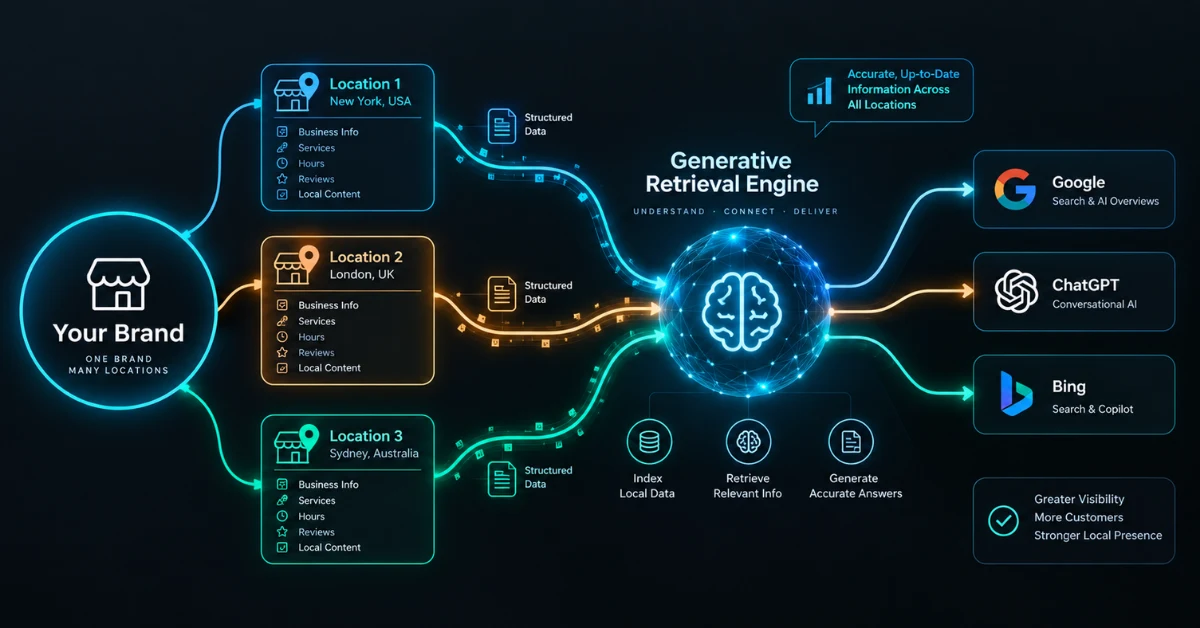


Modern marketing generates massive event streams across web traffic, CRM pipelines, ad platforms, and transaction logs. However, tracking historical metrics like page views, form submissions, and open rates only clarifies past campaign performance. Adopting predictive analytics in marketing using AI allows organizations to transform static data into forward-looking probabilistic models. Consequently, growth teams can forecast buyer actions, optimize campaign spend, and intervene before accounts churn.
Predictive models integrate historical customer datasets, statistical modeling, and machine learning to estimate future market behaviors. Rather than relying entirely on backward-looking retrospectives, marketing leaders leverage predictive intelligence to identify prospects with high purchase intent, detect retention risks, and reallocate advertising capital effectively.
Predictive Analytics vs Traditional Marketing Analytics
Understanding the operational shift between traditional reporting and algorithmic forecasting requires examining how data informs decisions across the organization.
| Capability | Traditional Descriptive Analytics | Predictive Analytics AI |
| Primary Metric | Historical actions (clicks, downloads, bounce rates) | Future event probabilities (conversion, churn, LTV) |
| Decision Style | Reactive adjustments after campaigns conclude | Proactive audience targeting and real-time intervention |
| Segmentation Basis | Static rules (job title, company size, geography) | Dynamic behavioral clusters and real-time intent spikes |
| Lead Prioritization | Manual point scoring based on rigid thresholds | Machine learning scoring trained on closed-won data |
| Data Requirements | Aggregated campaign metrics | Unified row-level interaction data and CRM event logs |
Moving from Historical Reporting to Forward-Looking Decisions
Standard marketing reporting evaluates metrics that cannot be changed. Knowing that an email campaign underperformed or that a paid search ad saw high click costs provides context, but it does not tell a growth team what adjustments to make next week.
Predictive models bridge this operational gap by detecting patterns hidden across disconnected business systems. When historical data reveals that accounts consuming specific product comparison pages alongside technical documentation consistently convert at twice the average rate, marketing teams can programmatically prioritize accounts demonstrating those exact behavior patterns.
Consequently, growth teams shift their perspective from asking what happened last quarter to determining which accounts require immediate sales intervention today.
How AI-Driven Predictive Analytics Forecasts Consumer Behavior
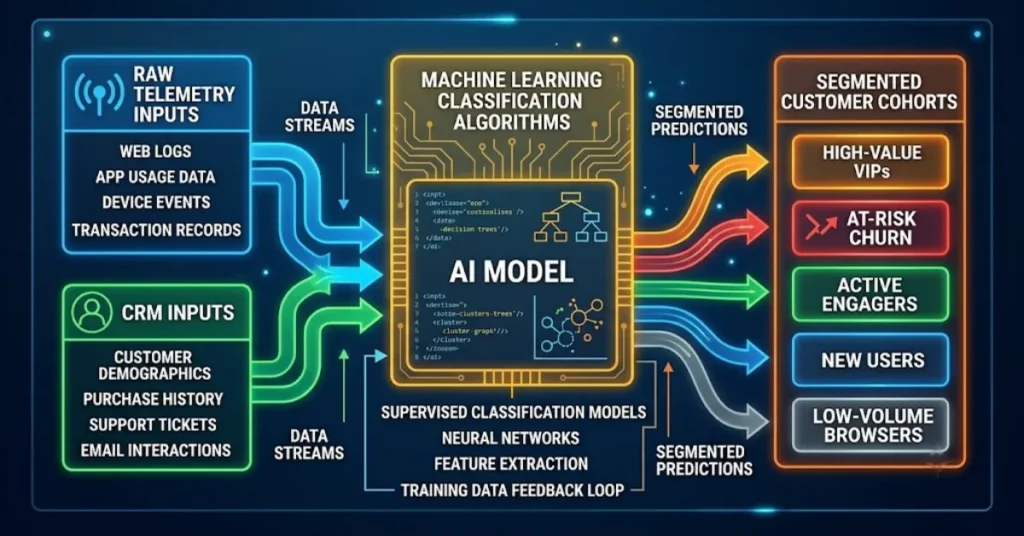
Modern marketing intelligence depends on uncovering non-linear customer journey patterns. In this context, predictive analytics and machine learning replace rigid point-scoring rules with adaptive models that learn continuously from conversion outcomes.
Specifically, data teams deploy supervised predictive analytics algorithms to evaluate diverse engagement variables:
- Propensity to Buy: Logistic regression and gradient-boosting models evaluate behavioral events, such as pricing visits and trial usage, to score customer conversion probability.
- Lookalike Audience Modeling: Neural networks analyze the behavioral vectors of high-LTV customers and match those traits across third-party networks to find identical prospects.
- Content Affinity Scoring: Natural language processing tracks consumed topics, triggering real-time content recommendations aligned with active buyer intent.
These models estimate probabilities rather than offering guarantees. Therefore, growth teams must interpret outputs as decision-support guidance to deploy sales and marketing resources where conversion velocity is highest.
Predictive Analytics and Prescriptive Analytics in Marketing Strategy
Organizations typically advance through distinct stages of data maturity. While predictive models forecast what will happen, prescriptive models recommend specific actions to take.
Combining predictive analytics and prescriptive analytics creates an automated decision loop. For instance, when a predictive model calculates that a high-value account has a 75% probability of churning, prescriptive logic suggests the specific intervention: dispatching an account executive, offering a specialized training module, or extending a targeted renewal incentive.
Furthermore, predictive analytics and forecasting enable marketing leaders to model quarterly pipeline contribution accurately. By projecting lead volumes against historical conversion velocity, revenue teams can identify potential pipeline deficits months before they impact revenue targets.
Predictive Lead Prioritization and Scoring
Generating inbound inquiries is rarely the bottleneck for mature sales organizations. Instead, the primary bottleneck is sales rep capacity and time spent on prospects with low buying intent. Traditional rules-based lead scoring assigns arbitrary points to activities, such as adding five points for a whitepaper download or ten points for visiting a pricing page. Consequently, this often leads to inflated scores for students, competitors, or unqualified researchers.
Machine learning replaces arbitrary points with algorithmic lead scoring. Supervised models evaluate multi-touch buyer journeys against historical won-and-lost deal records. Specifically, the algorithm weighs thousands of signal combinations:
- Historical win rates tied to specific business email domains and industry verticals.
- Time intervals between initial content consumption and direct demo requests.
- Product documentation visits originating from multiple internal stakeholders at the same company.
- Frequency of interactions across webinars, outbound outreach, and organic search.
These models calculate a calibrated probability score for every contact, allowing sales reps to focus direct outreach on prospects showing verified commercial velocity.
Strengthening Account-Based Marketing (ABM)
B2B organizations with extended sales cycles cannot afford to treat every enterprise account equally. Account-based marketing relies on identifying high-value target companies before direct outreach begins.
Predictive intelligence aggregates internal customer relationship data with external intent data. By monitoring third-party content consumption across industry publications, predictive platforms identify which accounts are researching specific problem spaces before those companies ever land on your website.
When marketing and sales teams share this intelligence, they execute unified territory plans:
- Sales development reps contact buying committee members during active research windows.
- Paid advertising teams trigger tailored programmatic display campaigns exclusively to IP ranges of accounts exhibiting high purchase intent.
- Content distribution shifts from broad industry overviews to deep, technical deployment blueprints.
Practical Predictive Analytics Applications Across Channels
Deploying artificial intelligence across the customer lifecycle unlocks clear operational efficiencies. The primary predictive analytics applications focus on three core areas:
1. Dynamic Customer Segmentation
Traditional demographic segmentation assumes that all businesses of similar size behave identically. In contrast, unsupervised clustering models group prospects by intent signals, separating high-velocity buyers from casual researchers and delivering messaging matched to their purchase stage.
2. Personalization at Scale
Predictive personalization adapts messaging dynamically. Rather than inserting a first name or company name into a static email template, predictive models recommend case studies, product modules, and technical resources that match the recipient’s specific buying stage.
3. Customer Churn Mitigation
Acquiring new customers is consistently more expensive than retaining existing accounts. Churn prediction models identify early reductions in usage telemetry, such as login drops or increased support tickets, weeks before an account submits a cancellation notice.
Implementing a Customer Churn Prediction Model
Protecting existing customer revenue is significantly more cost-effective than acquiring new business. Churn prediction models identify early degradation in customer engagement well before an account issues a formal cancellation request.
To deploy an effective churn model, data teams structure tracking around specific risk factors:
- Product Usage Reductions: Sharp drops in active daily logins, license utilization, or core feature adoption.
- Support Friction: Spikes in unresolved technical tickets, recurring bug submissions, or negative sentiment scores.
- Contract and Billing Milestones: Delayed invoice approvals, credit card expiration alerts, or approaching contract renewal dates without active rep engagement.
When an account crosses an established churn probability threshold, automated playbooks assign high-priority tasks to customer success managers to address service roadblocks directly.
Core Predictive Analytics Benefits for Growth Teams
Integrating machine learning into marketing operations delivers distinct predictive analytics benefits:
- Higher Return on Ad Spend: Algorithmic bid systems automatically raise bids on high-intent segments while suppressing impressions for unqualified audiences, reducing wasted spend.
- Shortened Sales Cycles: Directing sales development representatives toward high-propensity accounts prevents stalled pipeline deals.
- Improved Customer Lifetime Value: Identifying upsell windows through behavioral signals expands account value before renewal cycles begin.
- Data-Backed Budget Allocation: Quantitative forecasts provide clear justification for shifting budget across paid search, programmatic advertising, and account-based marketing campaigns.
Ultimately, leveraging predictive analytics business frameworks protects profit margins and ensures go-to-market teams operate with measurable efficiency.
Top Predictive Analytics AI Tools for Marketing Intelligence
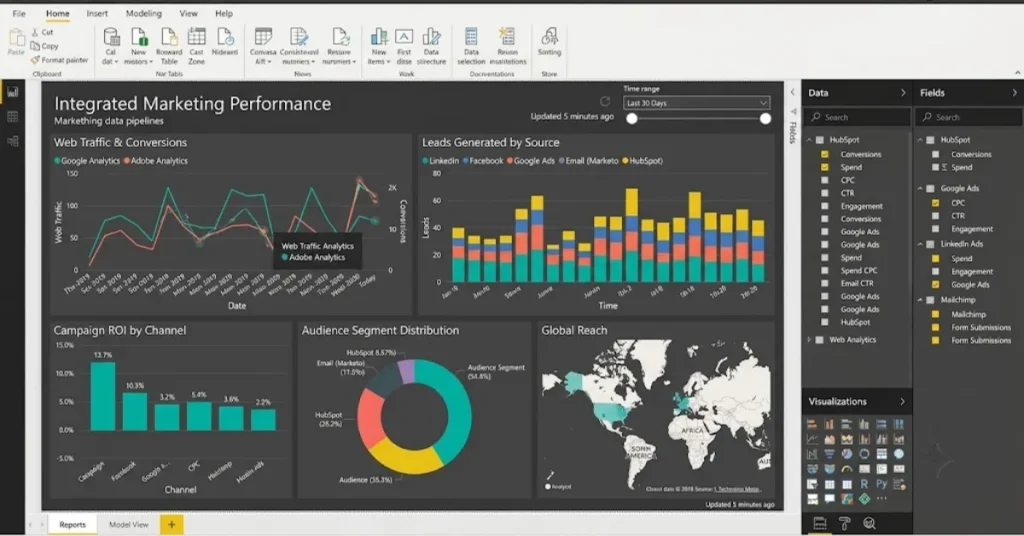
Selecting the appropriate platform depends on whether a company requires turn-key CRM automation or custom data modeling infrastructure. The leading predictive analytics ai tools offer varied capabilities:
| Platform | Primary Function | Core Strength | Operational Requirement |
| Salesforce Einstein | CRM-native predictive scoring | Direct synchronization with enterprise sales pipelines | Requires extensive historical deal history in Salesforce |
| HubSpot Marketing Hub | Inbound lead scoring and workflow triggers | Fast deployment without specialized data engineering | Limited flexibility for custom algorithmic modeling |
| 6sense | B2B account intent and buying stage tracking | Aggregates third-party B2B intent signals at scale | Enterprise-tier licensing and contract minimums |
| Power BI | Enterprise business intelligence and predictive dashboards | Flexible DAX modeling, Python integration, and custom visuals | Requires internal data analysis and BI development skills |
| Pecan AI | Automated predictive modeling on tabular data | Fast model training for churn, lifetime value, and demand | Requires connected data warehouse pipelines |
For organizations connecting customer data directly to internal executive reports, building custom business intelligence dashboards is often more effective than relying on closed vendor algorithms. For step-by-step setup and custom modeling techniques, review our guide on predictive analytics in Power BI methods and implementation.
Building the Necessary Data Foundation
Successfully implementing predictive analytics in marketing using AI requires reliable data pipelines. Attempting to deploy advanced algorithms on top of disconnected or dirty databases inevitably produces misleading forecasts and wasted ad spend.
Before training statistical models, teams must establish strict data hygiene:
- Remove duplicate contact records and reconcile split company accounts across CRM databases.
- Standardize lead source fields, campaign UTM parameters, and conversion milestones.
- Unify event tracking across website analytics, billing systems, and email automation platforms.
- Implement data governance standards to safeguard sensitive customer information and comply with privacy regulations.
Maintaining Human Oversight in Algorithmic Marketing
Predictive models evaluate historical patterns; however, they cannot account for unforeseen market events, macroeconomic shifts, or unexpected competitor moves. A model trained on historical performance data cannot foresee external supply chain disruptions or regulatory updates.
Marketing leaders must treat predictive tools as decision-support mechanisms rather than self-directed engines. Teams must monitor algorithmic recommendations, evaluate whether those projections align with current market conditions, and refine model parameters as consumer behavior evolves.