Let’s be honest. The SEO industry is full of guesswork. Most SEO gurus sell tricks based on old blog posts or pure random guesses. They tell you to buy fake profile links, worry about a secret Google “Sandbox,” or spend hours trying to get a green light on an SEO plugin.
Following obsolete advice wastes hundreds of hours tweaking elements that Google discarded over a decade ago.
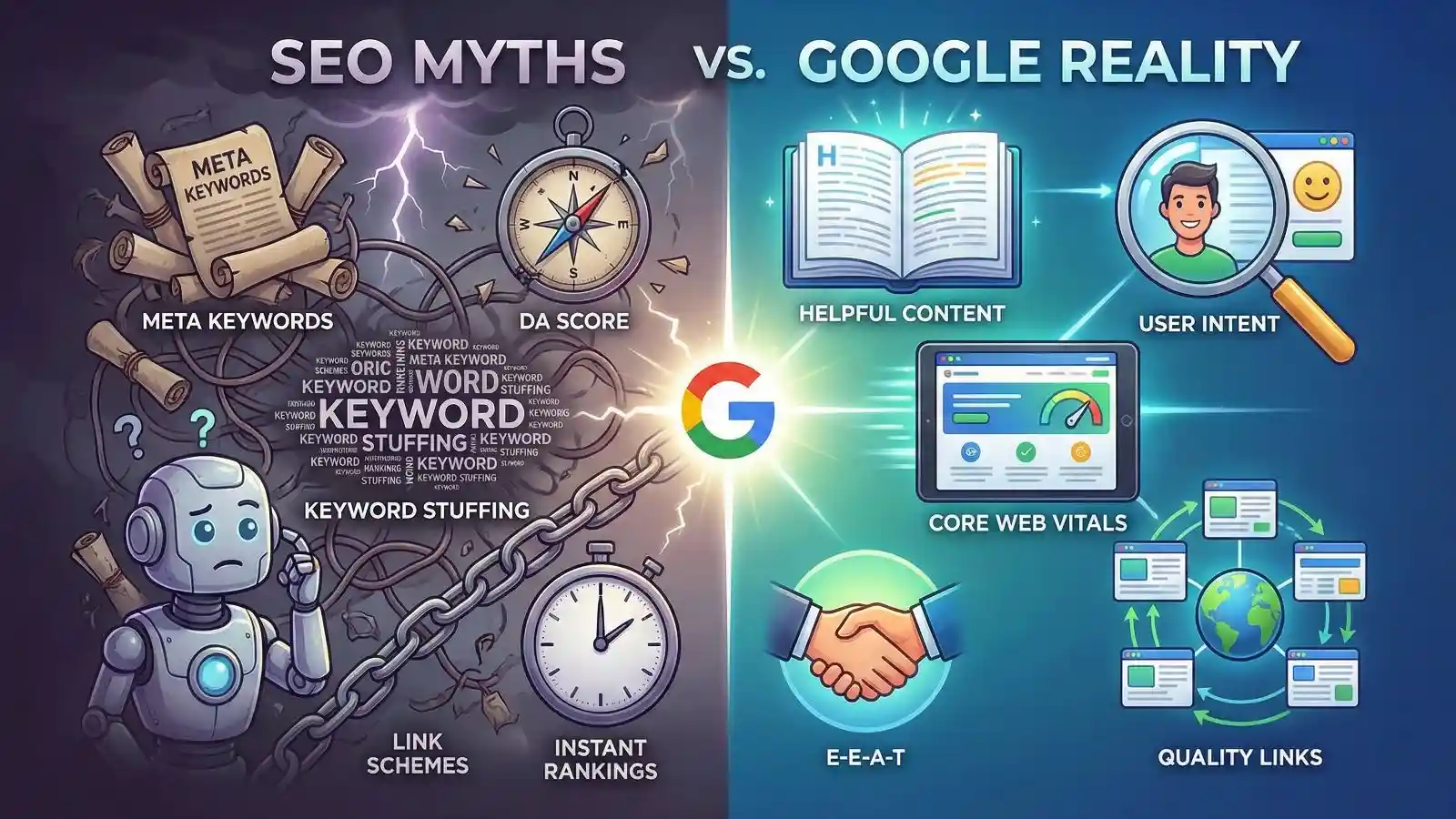
That is why we need an honest look at seo expectations vs reality. Today, we’ll look directly at the official Google Documentation to separatecommon marketplace myths from actual search realities.
However, that ends today.
The reason is that we are not going to rely on guesses. Instead, we are going to look at the Google Documentation itself.
What is “Google Reality” and E-E-A-T?
When it comes to growing your organic traffic, there is a massive gap between mainstream seo expectations vs reality. The expectation sold by most agencies is that you can buy a simple checklist or use a secret trick to fool a robot. The reality focuses entirely on human user satisfaction.
Modern search engines prioritize E-E-A-T
- Experience. Do you have first-hand knowledge?
- Expertise. Are you a pro in your field?
- Authoritativeness. Do others trust you?
- Trustworthiness. Is your site safe and honest?
If you plan to find a loophole to fool a robot, your strategy is a myth. If you plan to give the user the absolute best, most honest answer, you are living in Google Reality.
In this post, we will look at the biggest SEO myths holding your website back. First, we will look at the myth. Next, we will see the reality. Finally, I will give you the direct link to Google’s documentation so you can check it yourself or read it in detail.
Myth 1. The Meta Keywords Tag is Necessary for Ranking
The Myth: Webmasters must populate the <meta name="keywords"> tag in their HTML header with comma-separated target terms to help Google categorize the page.
The Reality: Google completely ignores this tag and has done so since 2009. Populating it is a waste of development time. Worse, it serves as a public roadmap telling your competitors exactly what terms you want to target.
The Technology: Modern search engines use advanced natural language processing models to read visible on-page content, rendering hidden keyword tags obsolete.
So, don’t waste five minutes filling out that box in your CMS. It is useless.
Google Documentation: “Google does not use the keywords meta tag in web ranking.”
Source: Google Search Central Blog – Google does not use the keywords meta tag
Myth 2. Copying a Paragraph or Having Similar Pages Will Get Your Site Penalize
The Myth: If you have two similar pages on your website, or if you quote a paragraph from another article, Google will hit you with a “Duplicate Content Penalty” and block your whole website.
The Reality: When looking at general google penalty myths the fear of a duplicate content penalty is the biggest one. There is no such thing as an automatic duplicate content penalty. When Google sees two identical pages, it simply picks the best one to show in search results and hides the other one. It does not punish your website unless you are automatically stealing thousands of pages from other sites to scam people.
The Fix: Implement standard canonical tags (rel="canonical") to explicitly state which URL is the master version.
Google Documentation: “Duplicate content on a site is not grounds for action on that site unless it appears that the intent of the duplicate content is to be deceptive.”
Source: Google Search Central – Duplicate Content Guidelines
Myth 3. H1 Tags Do Not Matter or You Can Use Unlimited H1s
The Myth: Heading tags are purely stylistic elements, or conversely, you can use five different H1 tags on a single page to rank for multiple primary keywords.
The Reality: Google uses heading structure to establish semantic hierarchy. While a page with multiple H1 tags will still be crawled, it destroys clear contextual structure.
Think of your page like a book. If a book has five titles, you don’t know what it is about. The H1 is your main headline. It helps Google understand the primary topic of the page. So, use exactly one H1 per page followed by logical sub-sections (H2, H3).
Google Documentation: “Google uses heading tags to understand the structure of the text on a page.”
Source: Google Search Central – SEO Starter Guide
Myth 4. Longer Word Count Automatically Equals Higher Rankings
The Myth: You must hit an arbitrary length, such as 2,000 words, for a blog post to rank number one on search engine results pages.
The Reality: Word count is completely absent from Google’s ranking factors. If a user’s intent can be solved thoroughly in 300 words, Google prefers that concise page over a 2,000-word essay filled with fluff.
The Technology: Google uses Information Gain scoring patents. The algorithm explicitly rewards unique information density, not raw text volume.
Don’t write more. Write better.
Google Documentation: “Word count is not a ranking factor.” — John Mueller.
Source: Google Search Central – Creating Helpful Content
Myth 5. Achieving a “Green Light” on SEO Plugins Guarantees High Visibility
The Myth: You must rewrite your copy until Yoast or RankMath displays a green optimization score, otherwise Google will reject the page.
The Reality: Google’s crawling systems have zero access to your internal CMS plugin scores. These plugins operate on basic, static regex formulas written by third-party developers. They do not emulate Google’s actual ranking systems. If a plugin forces you to write awkward, robotic sentences just to check a box, turn off the plugin.
Google Documentation: “Our systems aim to prioritize content that seems most helpful… based on expertise, experience, authoritativeness, and trustworthiness (E-E-A-T).”
Source: Google Search Central – E-E-A-T Guidelines
Myth 6. Third-Party Domain Authority (DA) Dictates Organic Performance
The Myth: You must optimize your link-building strategy to increase a numeric score ranging from 0 to 100 provided by Moz, Semrush, or Ahrefs.
The Reality: Google does not use Domain Authority or Authority Scores. These are proprietary commercial metrics engineered by software companies trying to reverse-engineer search data. Google uses its own internal systems, including the foundational PageRank graph, which cannot be measured via third-party dashboards. A niche site with a low third-party metrics score can easily outrank a massive corporate site if its on-page relevance and local trust indicators are superior.
So, stop buying “50 backlinks for $5.” Instead, earn one real link from a relevant blog in your industry.
Google Documentation: “Links intended to manipulate PageRank… includes low-quality directory or bookmark site links.”
Source: Google Search Central – Spam Policies (Link Spam)
Myth 7. Scaled Profile Creation and Directory Links Boost Domain Trust
The Myth: Buying automated packages that drop your link into random forum bios or obscure web directories builds an authoritative backlink profile.
The Reality: Google’s link-spam systems programmatically isolate and neutralize unnatural, low-effort links. They do not pass equity or PageRank. Spending money or time on bulk profile links does nothing for your site except introduce unnecessary algorithmic risk. One highly relevant link from a trusted, active platform in your specific vertical carries more weight than 1,000 artificial forum footprints.
Don’t overpay for old names. Focus on fresh value.
Google Documentation: “Domain age is not a ranking factor.” — John Mueller.
Source: Google Search Central – How Search Works
Myth 8. Guest Posting Exclusively on “High-Authority” Sites is a Flawless Link Strategy
The Myth: Publishing low-quality informational articles across generic, high-traffic multi-niche websites solely to secure a backlink is the best way to scale SEO.
The Reality: Google strictly penalizes large-scale article marketing syndication and paid guest-posting networks. If the outbound links are structurally unnatural, irrelevant to the host site’s core theme, or commercialized, Google’s systems will devalue them completely or flag the site for link manipulation.
Google Documentation: “Social signals are not a direct ranking factor.”
Source: Google Search Central YouTube – Matt Cutts on Social Signals
Myth 9. Domain Registration Age Determines Base Rankings
The Myth: A domain registered in 2010 possesses an inherent algorithmic advantage and will automatically outrank a fresh domain registered in 2026.
The Reality: Domain age is not a ranking factor. Google evaluates the live quality of content, the freshness of user interaction signals, and the current contextual relevance of the link profile. An old domain with an abandoned architecture holds no value over a brand-new domain executing a pristine content strategy.
Stop chasing a vanity number. Start chasing user satisfaction.
Google Documentation: “We don’t use Domain Authority. We don’t have a ‘website authority’ score.” — John Mueller.
Source: Google Search Central Twitter (Search Liaison)
Myth 10. Social Media Interaction Drives Organic Search Rankings
The Myth: Accumulating thousands of likes, shares, or retweets on Facebook, X, or Instagram instantly elevates your page’s organic position.
The Reality: Social signals are not direct ranking factors. Google’s web crawlers cannot reliably access, index, or parse private, dynamic social media feeds or temporary stories. Social media visibility only helps SEO indirectly: viral posts generate web traffic, which increases brand searches and naturally encourages external bloggers to link to your resource from actual websites.
Google Documentation: “Google does not want you to build links for the sake of SEO. Links should be a result of great content.”
Source: Google Search Central – Link Spam Guidelines
Myth 11. New Websites are Blocked by a Strict “Google Sandbox” Penalty
The Myth: Google puts every new domain into a secret, mandatory six-month probation period where it is mechanically barred from ranking for competitive keywords.
The Reality: The “Sandbox” does not exist as an intentional penalty mechanism. The stagnation new sites experience is simply a baseline lack of data. Google’s algorithms require time to crawl, discover, test, and build a history of user interaction signals before trust can be extended to highly competitive search queries.
Google Documentation: “It can take a bit of time for search engines to catch up with your content, and to learn to treat it appropriately.”
Source: Google Search Central – How Search Works
Myth 12. Submitting an XML Sitemap Forces Immediate Indexation
The Myth: Uploading a comprehensive sitemap via Google Search Console guarantees that every single URL within that file will appear in public search results.
The Reality: An XML sitemap is a non-binding discovery protocol, not a directive. It tells Google where your pages exist, but the indexing system decides whether a page deserves inclusion based entirely on content depth, originality, and technical health.
Google Documentation: “Using a sitemap doesn’t guarantee that all the items in your sitemap will be crawled and indexed.”
Source: Google Search Central – Sitemap Overview
Myth 13. A Robots.txt Disallow Directive Completely Prevents Indexation
The Myth: Adding a Disallow: /admin/ line to your robots.txt file is a secure method to hide sensitive or internal pages from Google’s search index.
The Reality: This is a severe technical oversight. A robots.txt file only restricts crawling (the bot reading the contents of the page). It does not stop indexing. If an external site links to your disallowed URL, Google can and will index that address based on metadata alone, displaying it in search results without reading the code. To properly hide a webpage, keep it crawlable but apply a strict <meta name="robots" content="noindex"> tag.
Google Documentation: “A robots.txt file is not a mechanism for keeping a web page out of Google… If you want to keep a web page out of Google, block indexing with noindex.”
Source: Google Search Central – Robots.txt Intro
Myth 14. Rel=”Canonical” Overrides Google’s Page Selection Systems
The Myth: Placing a canonical tag on a page forces Google to accept your preferred URL choice under all circumstances.
The Reality: Canonical tags are strictly hints, not absolute rules. Google analyzes a massive array of signals—including URL structures, internal linking density, sitemap listings, and redirect patterns. If the algorithm determines that a webmaster has incorrectly canonicalized distinct pages or pointed to an irrelevant asset, it will bypass your tag entirely and programmatically select its own canonical URL.
Google Documentation: “Indicating a canonical preference is a hint, not a rule.”
Source: Google Search Central – Canonicalization
Myth 15. “WordPress Ranks Better Than Wix/Shopify (CMS Ranking Factor)”
The Myth: Google gives a deliberate ranking boost to websites built on WordPress compared to those hosted on Shopify, Wix, Squarespace, or custom frameworks.
The Reality: Google’s crawler treats all systems identically. The bot reads raw, rendered HTML, CSS, and JavaScript. It does not know or care what content management system generated that code. As long as your site outputs optimized markup, loads efficiently, and presents a clean, structured schema, any mainstream platform can rank at the top of search results.
Google Documentation: “There’s no ranking boost for using WordPress… There’s no fundamental SEO difference between mainstream CMSs.” — John Mueller.
Source: Search Engine Roundtable – Google on Best CMS for SEO
Myth 16. You Must Use “LSI Keywords” Into Your Content to Rank
The Myth: Webmasters must use automated tools to find a specific list of latent semantic indexing terms and sprinkle them across paragraphs to build contextual relevance.
The Search Intent: If you look at your website data, you will see users constantly typing these exact phrases into search bars:
- do lsi keywords exist google john mueller
- lsi keywords seo myth
- google john mueller lsi keywords myth
- google does not use lsi keywords myth
- google does not use lsi keywords seo myth
The Reality: The straight answer to all of these searches is no. LSI keywords are completely imaginary. Google does not use this system in its search algorithms. Modern search engines rely on advanced artificial intelligence and transformer models to read your sentences naturally, just like a human reader does. Forcing an artificial list of related words into your paragraphs destroys readability and offers zero ranking benefits. Write naturally for your audience and ignore the tools telling you to stuff keywords.
Google Documentation: “There’s no such thing as LSI keywords, so if anyone who’s telling you otherwise is mistaken, sorry.” — John Mueller. Source: Google Search Central Official Communications
Myth 17. Every Third-Party “Toxic Link” Warning Requires Immediate Disavow Action
The Myth: When a commercial SEO tool flags automated or spammy external links under a “Toxic Backlink” metric, you must immediately upload a disavow file to prevent ranking drops.
The Reality: Toxic backlinks are a conceptual marketing product sold by third-party analytics dashboards. Google does not categorize links using a “toxicity score.” The algorithm automatically filters out and ignores incoming low-quality web spam. You only need to deploy the manual Disavow Tool if your site has received an explicit, manual webspam action notification in Google Search Console.
Google Documentation: “Internally, we don’t have a notion of toxic backlinks… for the most part, we work really hard to try to just ignore them.” — John Mueller.
Source: Search Engine Journal – Google on Toxic Links
Myth 18. Maintaining a Specific Text-to-HTML Code Ratio Improves Rankings
The Myth: Web developers must trim excessive HTML structure or JavaScript components to meet an arbitrary percentage ratio of code versus visible text.
The Reality: Text-to-HTML ratio has zero correlation with ranking algorithms. Google evaluates whether the user-facing content resolves search intent and whether the page satisfies core performance parameters. Trimming clean, necessary layout code to chase an imaginary metric ratio is a waste of development time.
Google Documentation: “Text to HTML ratio – is that a ranking factor? No.” — John Mueller.
Source: Search Engine Journal – Code To Text Ratio
Myth 19. Keyword Stuffing Your Business Profile Name Safely Accelerates Map Rankings
The Myth: Adding target services or local modifiers to your Google Business Profile name (e.g., “John’s Plumbing – Best Emergency Plumber New York”) is an approved, permanent local SEO growth hack.
The Reality: This approach yields short-term gains before triggering a hard, manual suspension. Google’s local guidelines strictly demand that your online listing title precisely match your registered legal entity name. Your listing will be flagged and removed from Google Maps the moment a local competitor suggests an edit or submits a direct complaint.
So, keep it clean. If your legal name doesn’t have keywords, don’t fake it.
Google Documentation: “Your name must not include… Marketing taglines… or Service information.”
Source: Google Business Profile – Guidelines for representing your business
Myth 20. “Daily Google Business Posts Improve Rankings”
The Myth: Treating your Google Business Profile like a social media feed by uploading promotional updates every 24 hours forces the Map Pack algorithm to rank your listing above competitors.
The Reality: Google Business updates do not directly influence localized map rankings. Posting frequency is not an organic signal. These operational updates are strictly designed to communicate promotional incentives or operating adjustments directly to prospective customers after they have successfully discovered your brand card. Focus your effort on securing authentic customer reviews and configuring precise categorization.
Google Documentation: “Posts allow you to communicate with your existing and potential customers.” (Note: Nowhere does it list “posting frequency” as a ranking factor).
Source: Google Business Profile Help – About Posts
Myth 21. “Bounce Rate is a Ranking Factor”
The Myth: A high bounce rate in your site analytics reports signals to Google that your content is low-quality, resulting in automated ranking drops.
The Reality: Google does not use standard analytics bounce rate to determine organic search rankings. A user can click a search result, find the exact answer they needed (e.g., a technical specification, a conversion rate, or an address), and close the tab. This constitutes a 100% bounce rate in traditional tracking software, yet represents perfect user satisfaction.
Google Documentation: “We don’t use bounce rate in search rankings.” — John Mueller.
Source: Google Search Central – Bounce Rate Myth
Myth 22. “You Must Have Short, Keyword-Rich URLs to Rank”
The Myth: You must rewrite old URLs to make them short and keyword-dense, even if those pages have been live and active for years.
The Reality: Keywords within a URL string represent a highly superficial, microscopic ranking signal. Rewriting an established URL breaks existing historical link structures, clears out built-up social proof counters, and forces Google to fully recrawl and re-evaluate the new address from scratch. The risk of losing historical domain authority far outweighs any minor aesthetic gain. If a URL is readable and functional, leave it intact.
Google Documentation: “Keywords in URLs are overrated for Google SEO… stick to something that works for your users.” — John Mueller.
Source: Google Search Central – URL Structure Guidelines
Myth 23. Google Automatically Penalizes or Bans AI-Generated Content
The Myth: Using ChatGPT, Claude, or any AI writing assistant to generate your text triggers an automatic algorithmic flag that stops your site from ranking.
The Reality: Google explicitly stated that using AI to create content is not against their guidelines. The algorithm evaluates the quality, accuracy, and helpfulness of the output, not the tool used to create it. If your AI content is just a rehash of existing web pages without unique value, it will fail E-E-A-T standards. But if it solves the user’s problem and offers deep insights, it will rank.
Google Documentation: “Our focus on the quality of content, rather than how content is produced, is a useful guide that has helped us deliver high-quality results to users for years.”
Source: Google Search Central – Guidance on AI-generated Content
Myth 24. Optimizing for AI Overviews (AIO) Requires a Separate Strategy From Standard SEO
The Myth: Traditional SEO is dead because of AI Overviews, so you need to buy expensive new tools to optimize specifically for Gemini or AI search engine answers.
The Reality: Optimizing for AI Overviews relies on the exact same foundational principles as traditional SEO. The AI models pull summaries from top-ranking, highly structured, authoritative web pages. If your content uses clear headings, directly answers specific questions, and features verified schema data, Google’s AI systems will naturally select your text for their automated summary boxes.
Google Documentation: “Google’s AI Overviews use our core web ranking systems to find the most relevant and helpful web pages for a user’s query.”
Source: Google Search Central – AI Overviews in Search
Myth 25. Schema Markup is a Direct Ranking Factor
The Myth: Adding extensive structured data code like Product, Article, or FAQ schema to your HTML automatically boosts your page positions in search results.
The Reality: Schema markup is not a direct ranking factor. It does not give your site an artificial algorithmic boost. Instead, schema serves as a structural translator that helps Google understand the exact entities and data points on your page. This understanding allows Google to award you rich snippets, star ratings, and placements in AI Overviews, which increases your click-through rates.
Google Documentation: “Using structured data alone is not a guarantee that your page will appear in search results with rich features, nor is it a ranking factor.”
Source: Google Search Central – Structured Data Introduction
Myth 26. Every Page on Your Website Must Be Indexed to Rank Well
The Myth: You must force Google to index every single thin tag page, author archive, and internal search result URL to maximize your site’s overall search authority.
The Reality: Flooding Google’s index with low-value, thin, or repetitive pages wastes your domain’s crawl budget and dilutes your site’s overall quality score. High-performing websites purposefully use the noindex tag on low-value administrative or archive pages. This forces Google’s crawler to focus 100% of its energy on your high-quality, conversion-focused pillar content.
Google Documentation: “You don’t need all URLs on your site to be indexed… focusing on high-quality pages is a better long-term strategy for your site’s visibility.” — John Mueller.
Source: Google Search Central Developer Sessions
Myth 27. Core Web Vitals Require a Perfect 100/100 Score to Rank
The Myth: You must spend thousands of dollars on specialized web developers to achieve a flawless 100/100 score on Google PageSpeed Insights, otherwise your rankings will tank.
The Reality: Google does not use the raw 0 to 100 PageSpeed score as a ranking factor. The actual ranking factor is Core Web Vitals, which relies on real-world user data over a rolling 28-day period. Your site simply needs to pass the minimum “Good” thresholds for metrics like LCP, CLS, and INP. Achieving a perfect 100 score provides zero additional ranking benefits over a site that comfortably passes the standard thresholds.
Google Documentation: “The core web vitals are a set of real-world, user-centered metrics… our systems do not look at a single aggregate performance score.”
Source: Google Search Central – Core Web Vitals and Google Search Results
Myth 28. Google Uses Your Internal Google Analytics (GA4) Tracking Data for Ranking
The Myth: Google looks at your internal GA4 dashboards to monitor your traffic spikes, goal conversions, or user sessions, and uses that proprietary data to determine your search rankings.
The Reality: Google does not use Google Analytics data in its organic ranking algorithm. This is an absolute wall kept for privacy, compliance, and anti-trust reasons. If Google used analytics data, websites without Google Analytics tracking scripts would face an unfair algorithmic disadvantage. The systems that crawl and rank your pages operate entirely independently from consumer web analytics software.
Google Documentation: “We don’t use Google Analytics data for ranking purposes.” — John Mueller.
Source: Google Search Central Developer Hangouts
Myth 29. High Keyword Search Volume Guarantees Organic Traffic Success
The Myth: If a third-party keyword tool shows a search volume of 50,000 monthly queries for a specific term, ranking for that keyword will guarantee massive traffic to your business.
The Reality: Raw search volume is a highly misleading metric. In modern search, click leakages are massive due to zero-click searches, automated calculations, and direct AI Overviews. A high-volume keyword might answer the user’s question completely on the search results page itself, leaving zero clicks for your website. Focus your strategy on matching deep informational intent and targeting transactional keywords that attract qualified buyers, rather than chasing high, empty numbers.
Google Documentation: “Search volume numbers from third-party tools are estimates… focus on queries that matter to your business users.” — John Mueller.
Source: Google Search Central Live Q&A
Myth 30. Fake Speed Tests and Mock Lab Scans Form the Basis of Your Rankings
The Myth: The instant automated speed tests you run inside developer tools are the exact baseline speed numbers Google uses to rank your website.
The Reality: Google completely ignores automated lab test environments when calculating your search rankings. The algorithm relies strictly on the Chrome User Experience Report, which aggregates real-world data from actual human beings accessing your website globally over a rolling 28-day window. If your website feels fast during a local mock test but lags heavily for real users on mobile network connections in daily life, your organic positions will drop regardless of your local testing scores.
Google Documentation: “The data collected by CrUX is available publicly through a number of Google tools… and is used by Google Search to inform the page experience ranking factor.”
Source: Google Chrome Developers Methodology Guide
Performance Tracking: Third-Party Vanity vs. Google Realities
Stop judging your online marketing success by tracking numbers invented by private software vendors. Focus entirely on the real systems that Google tracks internally.
| What You Track | Who Measures It | Does Google Use It for Ranking? | Actionable Reality |
| Domain Authority (DA) / Authority Scores | Private SEO Software | NO | These are proprietary guesses made outside of Google. They are completely invisible to Google’s ranking crawlers. |
| Google Analytics (GA4) Session Dashboards | Your Internal Analytics | NO | Private user tracking data is isolated from core ranking algorithms to maintain legal compliance and data equity. |
| PageRank Core Network Graphs | Google Infrastructure | YES | The foundational internal system Google uses to calculate link trust and source authority. This data is never exposed via public APIs. |
| Interface Responsiveness (INP) | Core Web Vitals | YES | An official user experience metric that measures how fast your website reacts when a human user taps on a button. |
| Information Gain Scores | Google Patent Office | YES | An internal algorithmic check that rewards websites for publishing unique insights or data points missing from other competing pages. |
| Real User Chrome Reports (CrUX) | Real Human Field Data | YES | The real delivery network Google uses to collect actual speed and performance data from genuine Chrome browser users globally. |
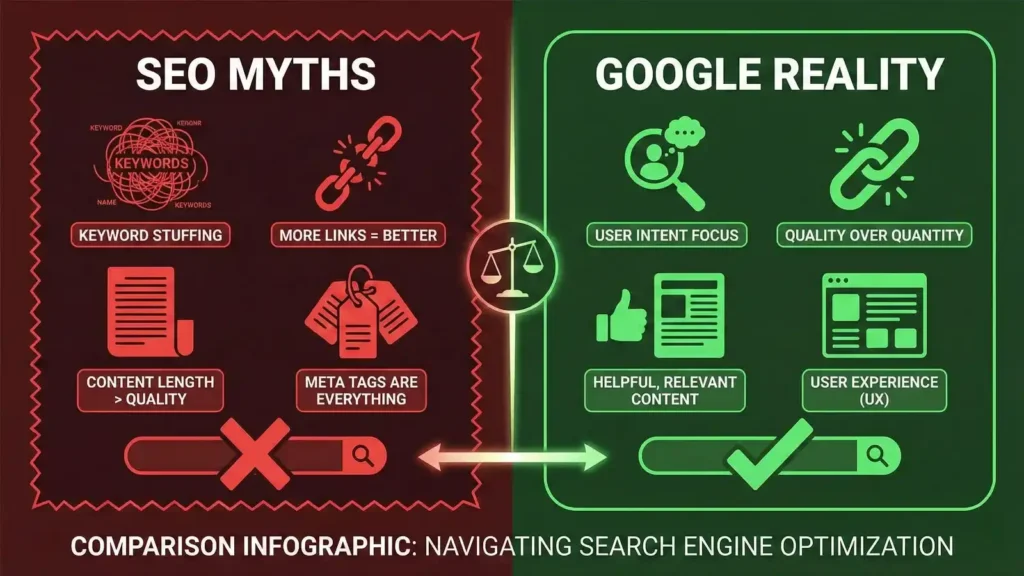
Technical Summary
SEO is simple. But people make it complicated.
Strategic organic growth requires zero guesswork. The true path to ranking ahead of your competitors involves building clean brand authority, fixing technical crawling paths, ensuring smooth screen responsiveness, and supplying real informational value to the human user.
Stop chasing algorithmic ghosts. Review your marketing roadmaps against real documentation and build a permanent business asset today.
Stop chasing ghosts. Start building a real brand.
Do the needful. Check your strategy today.