


Cladding in the UK is currently a loaded topic. You can hardly mention the word without triggering a debate about safety, compliance, and the legacy of the Grenfell tragedy.
But if you are a building owner, architect, or contractor, you cannot simply stop building. You still need a facade solution that protects the structure. It needs to look modern. Crucially, it must not present a fire risk.
This is where Alucobond Cladding enters the conversation.
Most people misunderstand what Alucobond actually is. They confuse the brand with the generic “ACM” (Aluminium Composite Material) that caused so many problems in the past.
Actually, Alucobond is one of the few products that has evolved to meet the new, stricter reality of UK construction. But you have to buy the right version.
So, let’s strip away the marketing noise. We will look at the hard facts: the alucobond cladding fire rating, the real costs, the installation pitfalls (like “oil canning”), and why CSS FACADES Ltd recommends specific systems for UK projects.
What Alucobond Cladding Actually Is?
Alucobond is the “Hoover” of the cladding world. It is a brand name so dominant that people use it to describe the entire category of aluminium composite panels.
But not all panels are the same.
Structurally, Alucobond is a sandwich. You have two 0.5mm aluminium cover sheets. Between them lies a mineral-filled core. This core is the most critical part of the entire system.
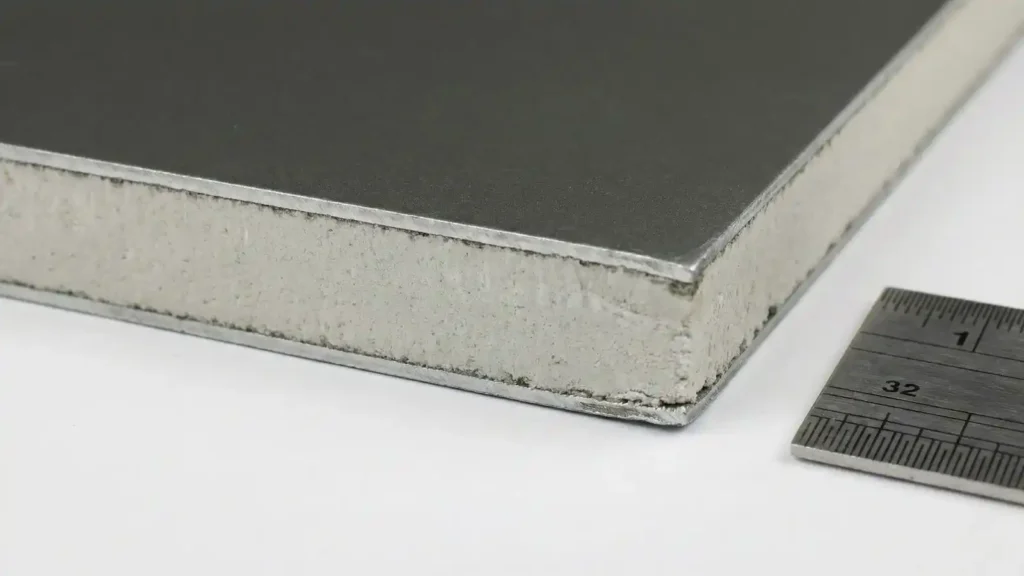
In the old days (and in cheap imports), that core was solid polyethylene (PE). PE is essentially petrol in solid form. It burns fiercely. You must never use PE core panels on high-rise buildings.
Modern alucobond cladding panels supplied by reputable dealers come in two main variations for the UK market:
- Alucobond Plus: A fire-retardant core.
- Alucobond A2: A non-combustible core.
The panel is lightweight, extremely flat, and rigid. This makes it perfect for alucobond rainscreen cladding systems where you want a crisp, engineered look without the massive structural load of solid stone or steel.
The Fire Rating Reality: A2 vs Plus
You are searching for alucobond cladding fire details because you are worried about compliance. You should be. The UK Building Regulations (specifically Approved Document B) have changed drastically since 2017.
You cannot just “guess” the fire rating. You need to look at the EN 13501-1 classification.
1. Alucobond Plus (Class B-s1, d0)
This is a “Fire Retardant” panel.
- Class B: Very limited contribution to fire.
- s1: Little or no smoke production.
- d0: No flaming droplets.
It is safe for many low-rise applications. However, on tall buildings, “limited contribution” is often not good enough for insurers or building inspectors.
2. Alucobond A2 (Class A2-s1, d0)
This is the gold standard.
- Class A2: Non-combustible.
- s1: Little or no smoke.
- d0: No flaming droplets.
The core of the A2 panel is almost entirely mineral. It does not burn. If you are working on a high-rise residential building, a hospital, or a school, Alucobond A2 is usually the mandatory choice.
CSS FACADES Ltd advises all clients to check their building height and use category before ordering. If you are over 18 metres (or even 11 metres in some contexts), do not risk it. Go for A2.
Alucobond Cladding Price
Why Is It So Hard to Get a Quote? Everyone wants a simple “price per square metre.” But cladding pricing is not linear.
The raw alucobond cladding cost for the sheet material might range from £50 to £100+ per m² depending on the finish and core. But that is just the skin. The final installed cost is often double or triple that figure.
Here is where your money actually goes:
1. The Waste Factor
Standard alucobond cladding sheet sizes are typically 1250mm or 1500mm wide. Lengths vary from 2500mm to 4000mm.
If your architect designs a panel that is 1300mm wide, we have to cut it from a 1500mm sheet. That 200mm strip is waste. You pay for it, but it goes in the bin.
2. The Fabrication
You can’t just glue the sheet to the wall. It needs to be fabricated.
- Face Fixed: The sheet is cut flat and riveted. This is the cheapest option.
- Cassette / Tray: The edges are folded back to form a box. This hides the fixings and stiffens the panel. This requires CNC machining and folding, which significantly increases the alucobond cladding price.
3. The Finish
Standard colours are affordable. But alucobond cladding colours include “Spectra” (colour-shifting) and “NaturAL” (brushed metal) finishes. These are premium products with premium price tags.
Common Alucobond Installation Problems: “Oil Canning”
Have you ever looked at a shiny metal building and noticed the walls look wavy or distorted? That phenomenon is called “oil canning.” It looks cheap, it looks amateur, and it is the number one complaint we hear from clients who used inexperienced installers.
This happens because aluminium is a reactive metal. It expands significantly when it gets hot. A dark grey panel in direct sunlight can reach temperatures of 80°C or more. When that happens, the metal wants to grow. If you have bolted that panel tightly to the wall at both ends, the metal has nowhere to go. It is forced to buckle outwards, creating those ugly ripples that ruin the facade’s reflection.
How We Prevent It?
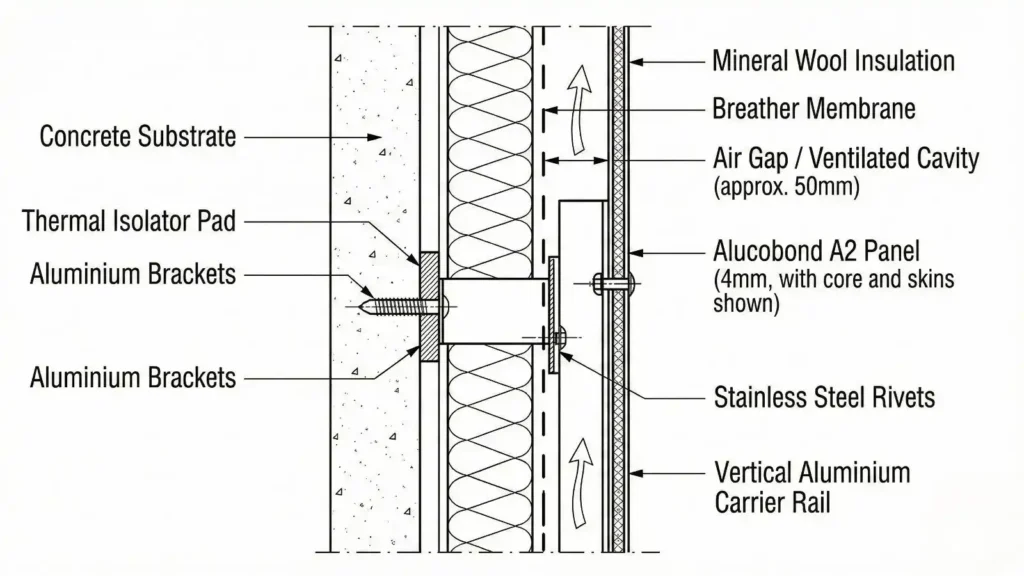
Correct alucobond cladding installation uses a system of “fixed points” and “sliding points.”
- Fixed Points: We place one single “fixed” point (usually in the centre of the panel) to hold it in position.
- Sliding Points: All other rivet holes are drilled slightly larger than the rivet itself. This creates a “floating” or “sliding” point.
- The Result: When the sun hits the panel and it expands, the rivets slide microscopically within these larger holes. The panel stays dead flat, and the stress is released without buckling.
If your installer gets this wrong, your expensive alucobond cladding system will look like a wrinkled crisp packet within a week.
Alucobond vs. Other Claddings
What Else Can You Use? We are realistic. While we believe Alucobond is the premier choice for most commercial facades, it is a premium product. Sometimes, specific budget constraints or the aesthetic vision of a project demand a different material.
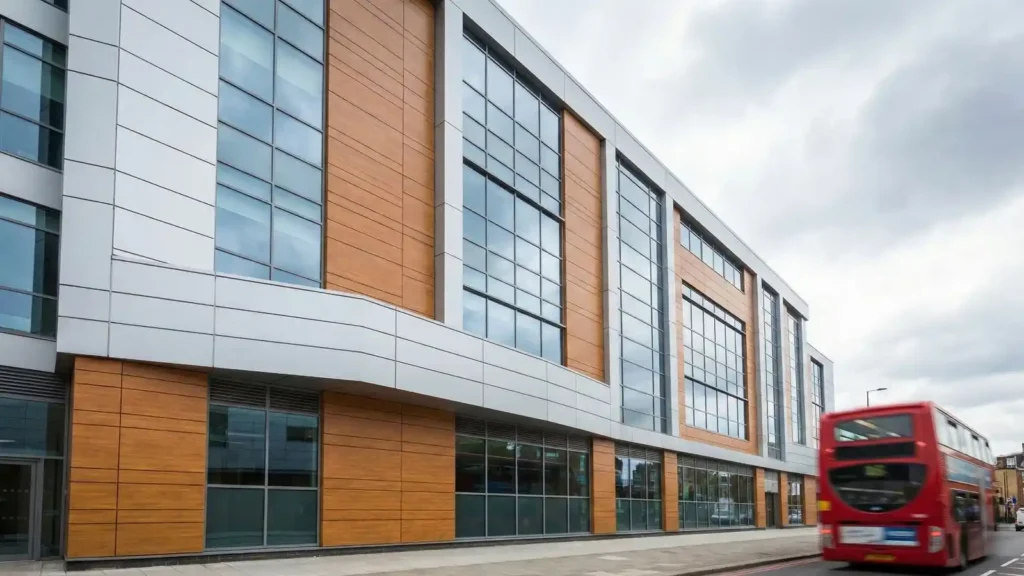
If you are evaluating your options, it is important to understand what else is available in the UK supply chain. Here are the three main rivals we frequently see specified against Alucobond:
1. Solid Aluminium Panels (PPC Aluminium)
This is often considered the “bomb-proof” option. Unlike Alucobond, which is a sandwich of materials, this is simply a raw sheet of architectural-grade aluminium, typically 3mm thick. It is powder-coated (PPC) to give it colour. Because it is solid metal through and through, it is often the default choice for projects where non-combustibility is the absolute only priority.
- The Difference: No core. No composite layers. Just a single, heavy sheet of metal.
- The Pro: It is A1 Non-Combustible by default. There is nothing to burn.
- The Con: It is heavy and difficult to handle. It is much harder to fold into crisp “cassette” shapes without cracking the paint. It also suffers more easily from “oil canning” (rippling) compared to the composite rigidity of Alucobond.
- Verdict: Use this if you need an A1 rating at all costs and are willing to accept a slightly less perfectly flat finish.
2. Fibre Cement (e.g., Equitone, Cedral)
If you prefer a natural aesthetic, you might be considering Equitone or Cedral. These are composite materials made of cement, cellulose, and minerals. They offer a matte, earthy texture that feels much like natural stone or [Recon GRC] to the touch, contrasting well with the metallic finish of Alucobond.
- The Pro: It feels natural and avoids the industrial look. It is usually rated A2 (safe).
- The Con: It is extremely heavy and brittle. You cannot fold it around corners like Alucobond; you have to cut it. If an installer drops a panel, it snaps instantly.
- Verdict: Great for a “natural” stone look, but be prepared for higher installation costs due to the weight.
3. High-Pressure Laminate (HPL) (e.g., Trespa)
You will often see this material on schools, hospitals, and low-rise apartment blocks. Leading brands like Trespa manufacture these panels by compressing wood fibres and resins under high heat. They are famous for their vibrant colours and convincing wood effects which can make a building look much warmer than aluminium ever could.
- The Difference: It is essentially a super-tough, exterior-grade laminate.
- The Pro: The wood effects are convincing and durable. It doesn’t dent easily.
- The Con: You must be extremely careful with fire ratings. Standard HPL is combustible. You must ensure you specify the “FR” (Fire Retardant) grade for any building of significant height.
- Verdict: Excellent for schools and low-rise offices that want a colourful, non-metallic appearance.
Alucobond vs. The Alternatives
Why not just use solid aluminium? Or fibre cement?
| Feature | Alucobond (ACM) | Solid Aluminium (3mm) | Fibre Cement |
| Weight | ~7.6 kg/m² (Light) | ~8.1 kg/m² (Heavier) | ~12+ kg/m² (Heavy) |
| Flatness | Excellent (Composite tension) | Fair (Can ripple) | Good |
| Fire Rating | A2 or B (Check Core!) | A1 (Non-Combustible) | A2 or A1 |
| Fabrication | Easy to fold by hand/routing | Hard to fold (Needs brake press) | Cannot fold |
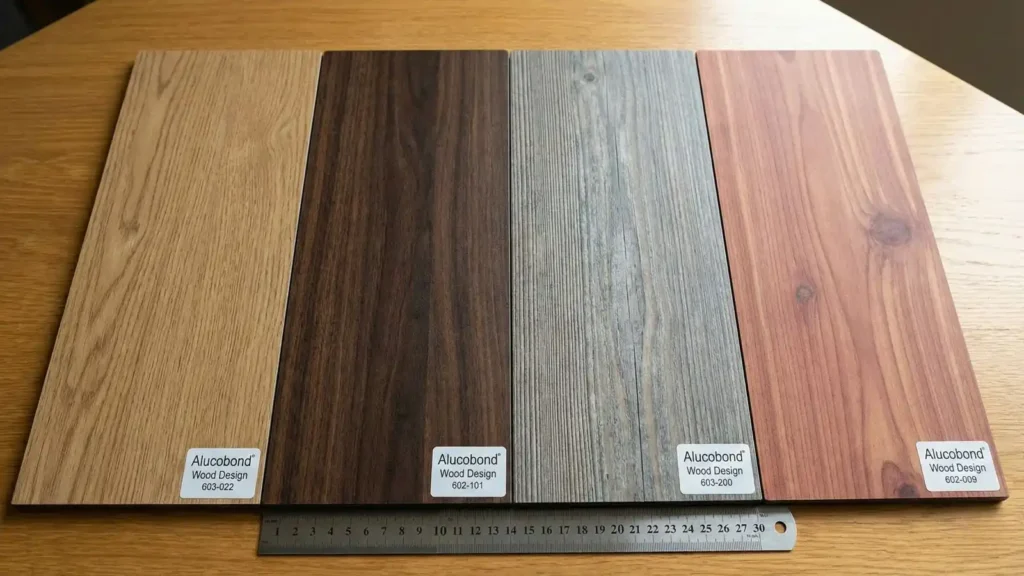
| Aesthetics | Metallic, Gloss, Wood, Stone | Powder Coat Only | Matte / Painted |
| Cost | Mid-Range | High (More raw metal) | Low – Mid |
Actually, Alucobond sits in the “sweet spot.” It is flatter than solid metal but lighter than fibre cement. It looks more expensive than it is.
Essential Alucobond Cladding Specifications
When you are writing the tender or ordering from CSS FACADES Ltd, you need to be specific. Do not leave room for ambiguity.
Use this checklist:
- Core Type: Clearly state “Alucobond A2” or “Alucobond Plus.” Do not just say “ACM.”
- Panel Thickness: Standard alucobond cladding thickness is 4mm (0.5mm skin / 3mm core / 0.5mm skin).
- Finish: Specify the exact colour code and gloss level.
- Grain Direction: For metallic and alucobond cladding texture finishes, the grain must run in the same direction on every panel. If you rotate one panel 90 degrees, it will look a different colour because of how the light hits the paint.
Fixing Details and Rainscreen Systems
Alucobond is almost always installed as a rainscreen.
This means the cladding is not the waterproof layer. The waterproof layer is the wall behind it. The cladding stops the rain from hitting the wall directly, but there is an air gap behind the panels.
This gap is vital. It ventilates the building. It stops condensation.
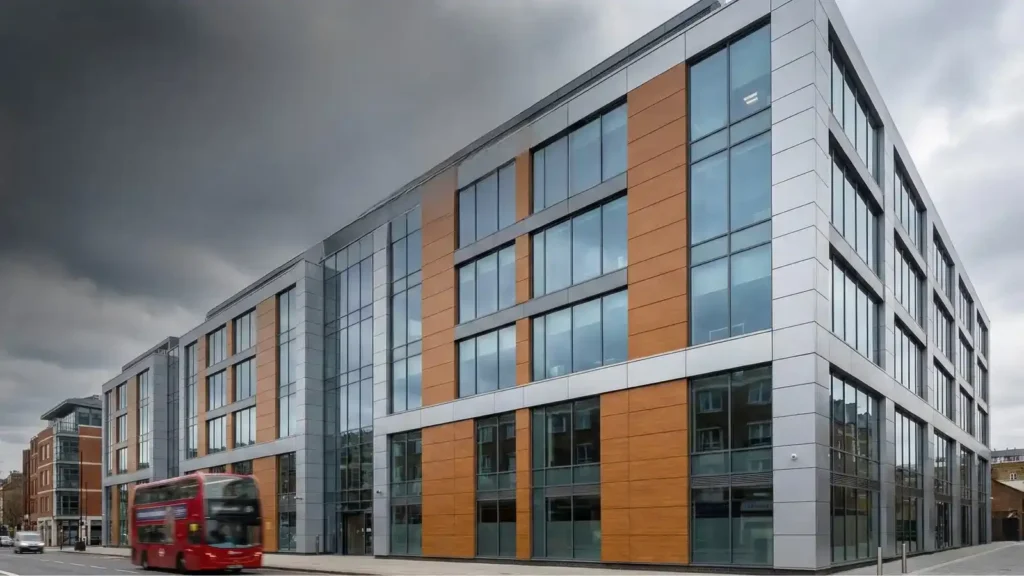
The alucobond cladding fixing details involve a carrier system. This is usually a set of aluminium rails bracketed to the wall.
- The Insulation: Sits against the building wall.
- The Breather Membrane: Protects the insulation.
- The Cavity: The air gap (usually 38mm – 50mm).
- The Panel: The visible Alucobond face.
If you block the cavity (at the top or bottom), the system fails. Damp will build up. Mould will grow.
The Contractor’s Checklist: Before You Order
(A guide to avoiding costly mistakes)
- [ ] Check the Fire Strategy: Has your fire engineer signed off on Class B (Plus) or do you strictly need Class A2?
- [ ] Wind Load Calculation: Have you calculated the wind pressure for your specific location? This determines the rail spacing.
- [ ] Optimisation: Have you checked your panel cuts against standard sheet sizes (1250mm/1500mm) to reduce waste below 15%?
- [ ] Access: Can you get 4-metre long sheets to the installation face?
- [ ] Batch Control: Order all panels from one batch to avoid slight shade variations.
Why CSS FACADES Ltd?
There are plenty of Alucobond cladding suppliers who will sell you a pallet of sheets and wish you luck.
We operate differently. We understand the system.
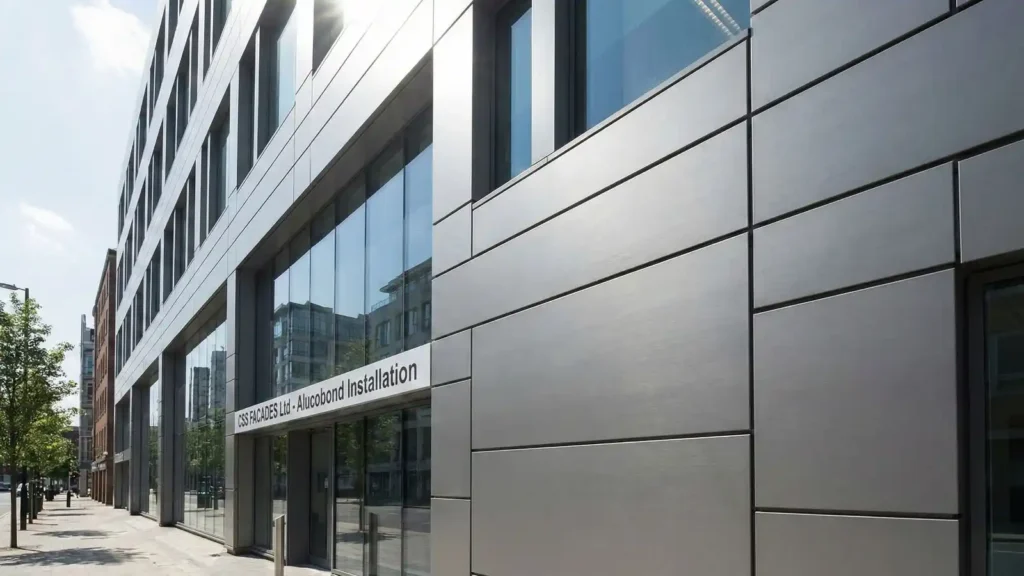
When you buy from CSS FACADES Ltd, you aren’t just buying a board. You are buying into a supply chain that understands:
- Which rails you need to support the wind load.
- How to minimise waste by optimising panel cuts.
- The exact fire barriers needed in the cavity to stop flame spread.
We supply the Alucobond cladding UK market with compliant, traceable materials. In an era of safety audits and Golden Threads, traceability is everything.










Leave a Reply
You must be logged in to post a comment.