

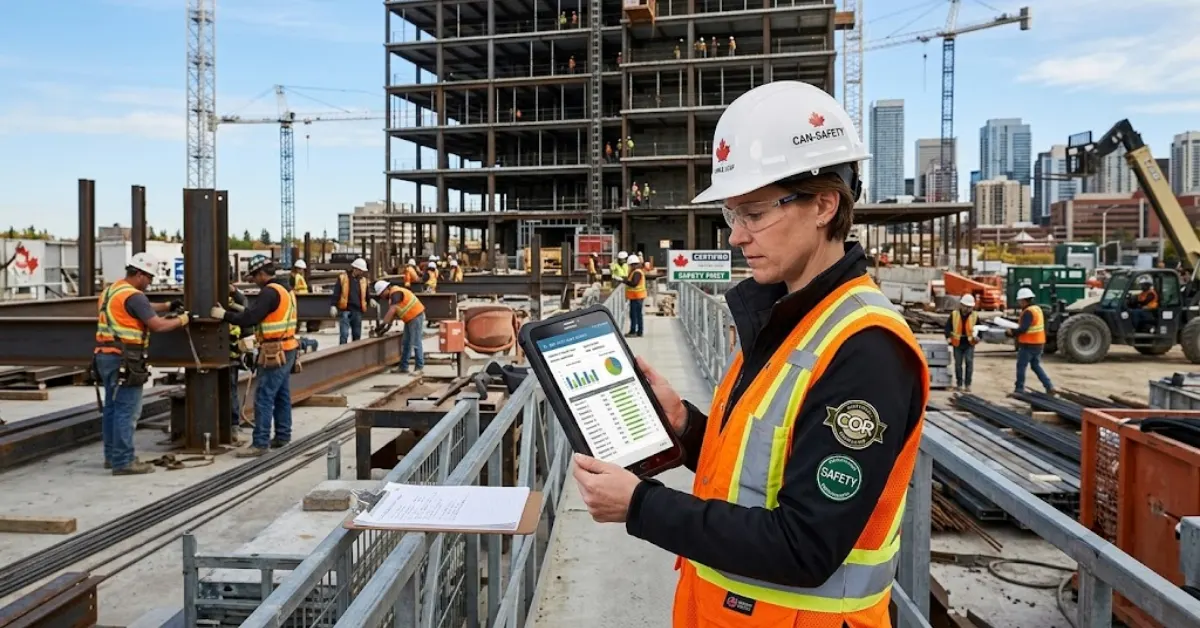
For commercial contractors and industrial service providers across Canada, winning major contracts requires more than low pricing. Municipalities, provincial infrastructure ministries, and tier-one general contractors mandate verified proof of safety before reviewing bids. In most Canadian jurisdictions, that proof is the Certificate of Recognition Canada program, universally known as COR certification.
The framework was first created in Alberta over two decades ago. Today, it serves as the benchmark for workplace safety compliance across the country. Holding this credential confirms that an employer has built an active safety system that has been independently audited and verified in the field.
What the Safety Standard Involves for Canadian Employers
A Certificate of Recognition verifies that an organization maintains an active health and safety program. The benchmark is governed nationally through CFCSA audit standards, which are recognized by construction safety associations in every province.
Basic regulatory compliance only requires meeting the minimum baseline rules of a provincial occupational health and safety act. In contrast, earning COR certification requires an active operational cycle of hazard assessment, worker training, regular inspections, and root-cause incident investigations.
The program is managed regionally by designated safety associations known as Certifying Partners:
- Ontario: Infrastructure Health and Safety Association (IHSA)
- Alberta: Alberta Construction Safety Association (ACSA)
- British Columbia: BC Construction Safety Alliance (BCCSA)
- Saskatchewan: Saskatchewan Construction Safety Association (SCSA)
- Manitoba: Construction Safety Association of Manitoba (CSAM)
These partners train internal company auditors, supply provincial audit tools, and review audit submissions before issuing official certification.
Commercial Value and Provincial Rebate Incentives
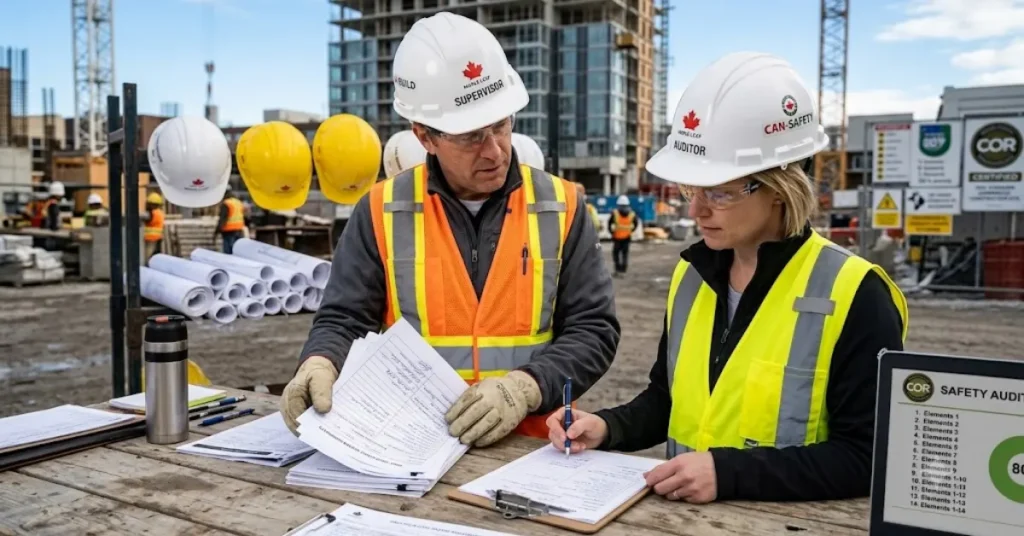
Building an audited safety system requires significant time and internal resources. However, the operational benefits and financial returns provide a strong return on investment.
- Eligibility for Major Tenders: Public procurement policies for transit systems, hospitals, and water infrastructure require mandatory COR certification. Without active standing, contractors are disqualified during initial prequalification.
- Workers’ Compensation Board (WCB) Rebates: Provincial compensation boards reward certified employers with direct premium refunds. In Alberta, the Partnerships in Injury Reduction program offers rebates up to 20%. In British Columbia, WorkSafeBC provides annual incentive payments up to 10%.
- Documented Due Diligence: If a critical workplace incident occurs, active standing proves that the employer exercised reasonable care to maintain legal workplace safety compliance.
- Lower Operational Downtime: Standardized safety controls reduce job site injuries, stop equipment damage, and prevent stop-work orders from provincial safety inspectors.
The 14 Core Audit Elements
To pass a formal COR safety audit, an employer must satisfy fourteen mandatory operational elements set by the national association.
| Audit Element | What Auditors Review | Required Documentation Evidence |
| 1. Company Safety Policy | Written executive commitment to safety | Signed management policy statement posted on job sites |
| 2. Hazard Assessment & Control | Daily hazard identification before shifts begin | Field-level hazard assessments and formal task risk analyses |
| 3. Safe Work Practices | Standard written guidelines for daily tasks | Safe work practice manual reviewed annually |
| 4. Safe Job Procedures | Step-by-step instructions for high-risk work | Written procedures for confined spaces, rigging, and heights |
| 5. Company Safety Rules | Clear behavioral and site-conduct expectations | Employee handbooks with signed worker acknowledgment forms |
| 6. Personal Protective Equipment | Verification of PPE selection, condition, and fit | PPE hazard assessments, fit-test logs, and maintenance records |
| 7. Preventative Maintenance | Scheduled maintenance for tools and heavy equipment | Daily pre-use inspection sheets and mechanic service logs |
| 8. Training & Communication | Structured worker onboarding and safety meetings | Signed new hire orientation sheets, toolbox talks, and tickets |
| 9. Workplace Inspections | Regular physical audits of active site conditions | Documented site inspection reports with closed corrective actions |
| 10. Incident Investigation | Root-cause analysis on injuries and near-misses | Formal investigation reports and corrective action tracking |
| 11. Emergency Preparedness | Operational readiness for critical site emergencies | Site-specific evacuation plans and documented emergency drill logs |
| 12. Statistics & Records | Tracking safety performance metrics over time | Monthly incident summaries, injury frequency rates, and WCB logs |
| 13. Legislative Compliance | Alignment with provincial occupational safety acts | Posted provincial safety acts, posters, and joint committee postings |
| 14. Health & Safety Committee | Active Joint Health and Safety Committee participation | Monthly JHSC meeting minutes, recommendations, and sign-in sheets |
Understanding SECOR vs COR Program Paths
The certification framework accounts for the difference between small trade crews and large industrial firms by offering two paths. Choosing correctly between SECOR vs COR depends strictly on company headcount.
- Small Employer Track (SECOR): Built for smaller trade operations. In Alberta, SECOR covers companies with up to 10 employees. In British Columbia, the small employer cutoff is 19 workers. The SECOR vs COR comparison shows that small employers follow the same safety rules but have lighter paperwork. In addition, small business owners can complete internal self-assessments instead of paying for third-party auditors.
- Standard Certification (COR): Required for employers exceeding small business headcount thresholds. These companies must meet full documentation standards, appoint certified internal auditors, and hire certified external auditors for certification reviews.
The Step-by-Step Implementation and Audit Process
Securing a Certificate of Recognition Canada credential takes six to twelve months for most businesses. The journey follows five structured phases:
- Step 1: Register with the Regional Certifying Partner: Enroll with your provincial construction safety association to access official audit tools, templates, and guidelines.
- Step 2: Complete Mandatory Training Modules: Send a permanent full-time employee and a member of senior management to finish required safety program administration and internal auditor courses.
- Step 3: Build the Safety Management System: Draft the company safety manual, site emergency plans, and safe work procedures covering all CFCSA audit standards.
- Step 4: Execute in the Field (3 to 6 Months): Put policies into daily practice across active job sites. Crews must generate verified records, including signed toolbox talks, daily hazard cards, and equipment maintenance sheets.
- Step 5: Conduct the Internal Review: The trained internal auditor completes a thorough pre-audit to locate compliance gaps, update missing records, and resolve open corrective actions before external evaluation.
- Step 6: Pass the External COR Safety Audit: An accredited third-party auditor evaluates the company using documentation review, site observations, and direct worker interviews.
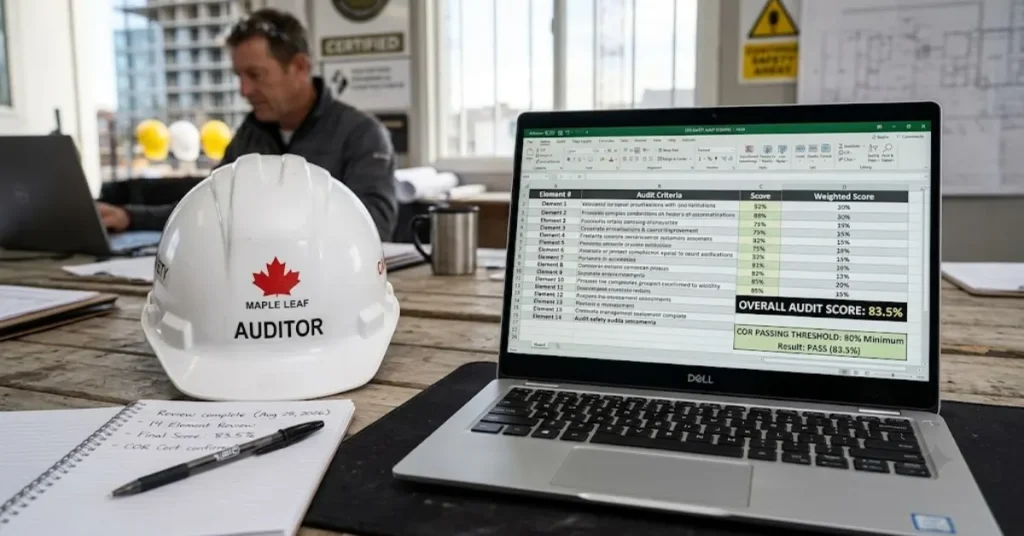
To achieve COR certification, an employer must score at least 80% overall on the COR safety audit, with a minimum score of 50% to 65% in each individual audit element depending on the provincial association.
Audit Maintenance and National Reciprocity
A Certificate of Recognition is valid for three years. However, maintaining valid standing requires ongoing verification. Employers must complete and submit annual internal maintenance audits during years two and three.
If an organization fails to submit its maintenance audit on time, its certificate is suspended. This suspension removes the company from approved bidding lists and cancels provincial workers’ compensation rebates. At the end of year three, the business must pass another full external COR safety audit to renew certification for another three-year cycle.
National Reciprocity Across Provinces
Contractors working across provincial borders can take advantage of national reciprocity. If an employer holds an active Certificate of Recognition Canada credential in its home province, it can apply for reciprocal standing with another provincial authority. The company only needs to complete a local legislative review to verify compliance with the destination province’s safety acts, eliminating the need to rewrite its entire safety manual.