
Commercial access control presents persistent operational challenges for expanding enterprises across Greater Auckland. If your facility needs a master key system auckland installation, managing locks and keys through an engineered structural hierarchy eliminates physical key clutter. Experienced technicians install patent-protected keyways to solve security vulnerabilities across all commercial properties.
Implementing a structured master key architecture allows business owners to govern access rights across multiple departments, commercial tenancies, and perimeter gates from a single physical key. Hiring a commercial locksmith auckland specialist ensures the system prevents unauthorized key duplication, cuts re-keying costs, and protects commercial assets throughout Auckland industrial zones and commercial districts.
What Is a Commercial Master Key System
A commercial master key system comprises a network of pin-tumbler lock cylinders configured to operate with individual staff keys while responding simultaneously to a single master key. Individual change keys open only assigned operational doors, whereas senior supervisors carry master keys that open every cylinder across the facility.
Commercial properties throughout the Auckland Central Business District, Penrose, Albany, and Highbrook rely on master key systems to balance internal convenience with tight perimeter defense. Educational campuses, healthcare centers, logistics warehouses, and corporate offices deploy these systems to eliminate physical key clutter. This structure guarantees immediate administrative access to all rooms during facility emergencies.
Standard residential pin-tumbler locks operate using a single shear line with bottom key pins and top driver pins. Commercial master key systems incorporate intermediate brass master wafers between the driver and bottom pins inside each pin chamber. These extra wafers establish multiple shear lines, permitting two completely distinct key cut profiles to turn the same cylinder plug smoothly.
How Does Master Keying Work Inside Lock Cylinders

Master keying functions by creating secondary shear lines inside the cylinder brass plug through precision master split pins or wafers. When an employee inserts an individual change key, the bottom pins raise flush against the plug perimeter along the primary shear line. When management inserts the master key, the cut depths lift the intermediate master split pins to align with the secondary shear line, allowing rotation.
Standard commercial cylinders contain five or six pin chambers drilled vertically through the housing and rotating plug. In a master keyed cylinder, technicians calculate exact mathematical pin depths across each chamber using dedicated computer matrix software. This calculation prevents accidental key interchange, where a key cut for one office inadvertently operates a different office lock.
Master keying inherently reduces the mathematical pick resistance of standard cylinders because every extra master wafer introduces additional shear lines. To neutralize this mechanical vulnerability, Auckland commercial facilities deploy restricted key systems nz businesses trust for high-security defense. Restricted systems feature side-milling pins, undercut key grooves, and strict legal distribution contracts to prevent physical picking and unauthorized key duplication.
What Are the Hierarchy Levels in a Master Key Architecture

Large commercial enterprises and multi-site Auckland companies structure access control across distinct organizational tiers. Designing a clear mechanical hierarchy prevents operational overlap, streamlines key assignment, and limits physical access to authorized staff members.
A multi-tiered commercial master key architecture typically organizes into four distinct structural levels:
- Great Grand Master Key
A universal top-tier key held by regional operations directors to operate every lock cylinder across multiple corporate locations and independent Auckland satellite facilities. - Grand Master Key
A high-level operational key designed for facility directors that opens every cylinder across all departments within a single primary commercial property or warehouse complex. - Master Key or Sub-Master Key
A departmental supervisory key that opens a designated cluster of doors, such as all accounting suites, IT server rooms, or ground-floor distribution offices. - Change Key or Servant Key
An individual low-level key assigned to a specific employee that opens only their private office or dedicated workstation door.
Structuring your access system across logical tiers protects enterprise security during everyday personnel transitions. When a change key goes missing, a licensed commercial locksmith auckland contractor re-pins that individual cylinder without re-keying the remainder of the commercial facility.
What Is the Difference Between Standard and Restricted Key Systems
Standard commercial key blanks remain freely available through hardware retail chains and mall kiosks across New Zealand. Anyone holding a standard key can duplicate copies within minutes without presenting proof of ownership, destroying key tracking and enterprise access control.
Unlike generic hardware, restricted key systems nz commercial managers implement use patent-protected key profiles that retail shops cannot stock or machine. Specialist commercial lock manufacturers supply these restricted blanks exclusively to accredited master locksmiths holding formal licensing agreements. Duplicate keys cannot be cut without formal written approval from designated company signatories registered in the locksmith secure database.
Every restricted key blank features a stamped sequential identification number linked to a permanent digital key register. Facilities managers maintain complete audit oversight over how many keys exist, who holds them, and when duplicates are commissioned. Restricted key profiles also incorporate complex mechanical broaching that resists physical lock bumping and decoding attacks.
What Does a Master Key System Cost in Auckland
Calculating typical master key system cost nz figures depends on cylinder volume, security tiering, and door hardware conditions. Upgrading standard commercial cylinders using an existing keyway typically costs between $60 and $100 NZD per cylinder for labor and precision re-pinning.
Installing high-security patent-protected restricted cylinders generally ranges between $140 and $260 NZD per door, including brand-new commercial cylinder hardware and site installation. Factory-stamped restricted keys cost between $25 and $45 NZD each, reflecting legal patent protections and specialized machining protocols. Standard commercial on-site travel fees across Auckland commercial zones add $90 to $150 NZD depending on travel distance.
A compact Auckland retail storefront or medical clinic with six doors typically invests between $900 and $1,600 NZD for a restricted master setup. A larger corporate office or multi-tenanted commercial facility containing thirty to fifty doors ranges between $4,500 and $11,000 NZD. Estimating full master key system cost nz project expenses early helps companies budget for modular retrofitting across existing lock hardware.
How to Avoid Unlicensed Commercial Locksmith Operations
Auckland commercial building owners must verify the legal credentials of any locksmith contractor working on physical access systems. Unlicensed operators and rogue lead generation agencies regularly target commercial businesses with unrealistic telephone quotes before delivering substandard, unkeyed hardware.
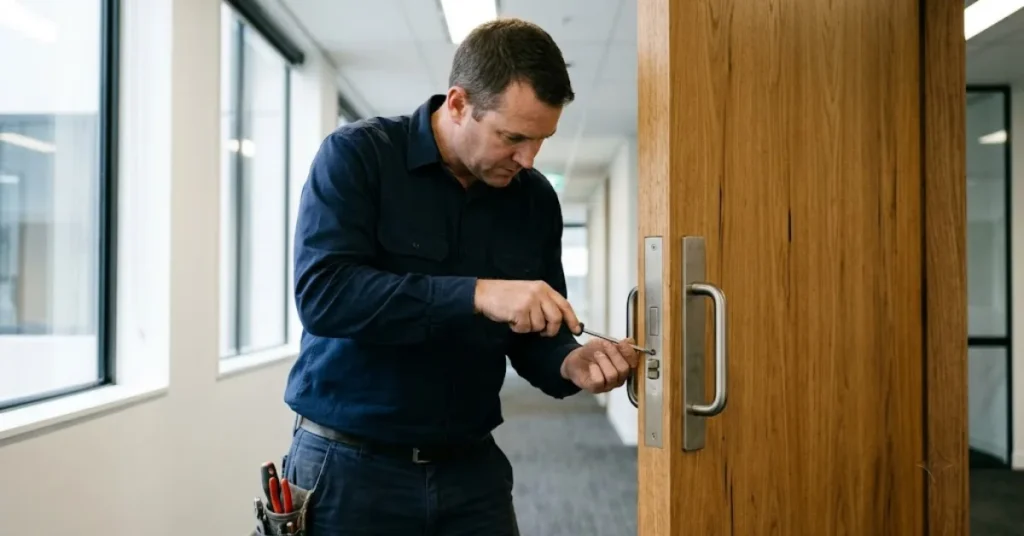
In New Zealand, any individual or enterprise providing commercial locksmithing services must hold an active licence issued by the Private Security Personnel Licensing Authority under the Ministry of Justice. The PSPLA conducts mandatory criminal background checks and fingerprint vetting to ensure commercial locksmiths possess verified integrity.
Always demand the technician display their physical PSPLA identification badge before granting access to your commercial door cylinders. Furthermore, confirm that your chosen commercial locksmith auckland partner belongs to recognized industry trade organizations such as the Master Locksmiths Association of Australasia. Certified practitioners adhere to strict trade standards and comply with all consumer guarantees under the Fair Trading Act.
Can an Existing Auckland Building Be Converted to a Master Key System
Most commercial properties can transition to an engineered master key system auckland facilities require without replacing existing door lock furniture. Commercial mortice locks, rim nightlatches, panic exit devices, and exterior glass entry doors generally house modular cylinders that detach easily for workshop servicing.
A commercial locksmith audits existing architectural hardware on site to evaluate cylinder compatibility across all entry points. If the locks utilize standard commercial oval cylinders, euro profile cylinders, or round brass screw-in cylinders, technicians re-pin the internal plugs to match the new matrix. This modular retrofitting strategy preserves expensive commercial lever handles while reducing labor and material costs.
Locks displaying severe internal casing corrosion, worn internal cams, or non-standard imported dimensions require physical hardware replacement. Upgrading worn door hardware during the initial master key installation ensures dependable daily cycling and prevents unexpected commercial lockouts.
How to Manage a Commercial Keying Schedule and Prevent Common Mistakes
The most destructive mistake a commercial business can make is treating a master key system as an informal collection of keys. Failing to maintain a formal digital key register allows keys to slip away unnoticed during routine staff turnover, invalidating the entire security investment.
Designate one or two authorized operational signatories within your organization empowered to order replacement keys from your licensed locksmith. When investing in restricted key systems nz businesses require, record the unique sequential stamp code, the recipient name, the issue date, and the assigned access tier in a secure internal spreadsheet. Conduct bi-annual key audits to verify all master, sub-master, and change keys remain in the hands of authorized staff.
Another frequent design error is failing to anticipate future operational growth during the initial engineering phase. If a locksmith designs a master matrix that accounts only for current doors, adding new offices later can cause key cut collisions. Experienced commercial locksmiths engineer reserve capacity into the initial matrix, allowing Auckland businesses to integrate new tenancies without rebuilding the entire system.